Terraform recipe: S3 Bucket with notification to Lambda Function
It might come handy to quickly have setup a bucket that notifies a lambda function on any operation, like for example putting a new object.
It’s a mix of aws_s3, aws_lambda and aws_iam definitions that altogether
deploys this in a matter of seconds. The only precondition is to have completed
the AWS CLI
setup.
With this minimal folder:
.
├── lambda
│   ├── index.js
│   ├── lambda.zip
│   └── package.json
├── s3.tf
And in less than 100 lines, you’ll have all this ready:
terraform {
  required_providers {
    aws = {
      source  = "hashicorp/aws"
      version = "~> 6.0"
    }
  }
}

provider "aws" {
  region = "eu-central-1"
}


data "aws_caller_identity" "current" {}

resource "aws_s3_bucket" "bucket" {
  bucket        = "your-bucket"
}

data "aws_iam_policy_document" "assume_role" {
  statement {
    effect = "Allow"

    principals {
      type        = "Service"
      identifiers = ["lambda.amazonaws.com"]
    }

    actions = [
      "sts:AssumeRole"
    ]
  }
}

data "aws_iam_policy_document" "access_cloudwatch" {
  statement {
    effect = "Allow"

    actions = [
      "logs:CreateLogGroup",
      "logs:CreateLogStream",
      "logs:PutLogEvents"
    ]

    resources = ["arn:aws:logs:*:${data.aws_caller_identity.current.account_id}:log-group:*"]
  }
}

resource "aws_iam_role" "iam_for_lambda" {
  name               = "iam_for_lambda"
  assume_role_policy = data.aws_iam_policy_document.assume_role.json
}

resource "aws_iam_role_policy" "iam_role_policy_for_lambda" {
  name    = "cloudwatch-access"
  role    = aws_iam_role.iam_for_lambda.id
  policy  = data.aws_iam_policy_document.access_cloudwatch.json
}

data "archive_file" "lambda" {
  type        = "zip"
  source_file = "${path.module}/lambda/index.js"
  output_path = "${path.module}/lambda/lambda.zip"
}

resource "aws_lambda_permission" "allow_bucket" {
  statement_id  = "AllowExecutionFromS3Bucket"
  action        = "lambda:InvokeFunction"
  function_name = aws_lambda_function.func.arn
  principal     = "s3.amazonaws.com"
  source_arn    = aws_s3_bucket.bucket.arn
}

resource "aws_lambda_function" "func" {
  filename      = data.archive_file.lambda.output_path
  function_name = "func-name"
  role          = aws_iam_role.iam_for_lambda.arn
  handler       = "index.handler"
  runtime       = "nodejs24.x"
  code_sha256   = data.archive_file.lambda.output_base64sha256
}

resource "aws_s3_bucket_notification" "bucket_notification" {
  bucket = aws_s3_bucket.bucket.id

  lambda_function {
    lambda_function_arn = aws_lambda_function.func.arn
    events              = ["s3:ObjectCreated:*"]
    filter_prefix       = "path-to-prefix-if-needed/"
    filter_suffix       = ".suffix-if-needed"
  }

  depends_on = [aws_lambda_permission.allow_bucket]
}
lambda/lambda.zip being simply a bundle of both index.js and
package.json. You can generate or update anytime with zip -r lambda.zip .
while sitting in the lambda directory.
You can start with a minimal index.js like:
exports.handler = async (event, context) => {
  console.log('Event: ', JSON.stringify(event));
};
As a result, a log is pushed to CloudWatch anytime an object is pushed into the S3 bucket. It’s handy for me to have it here, I’ll reuse that pretty soon. More later!
Rendering an Image via CSS linear-gradients
I’ve lately done my own exploration of what is possible with one single div
element and a couple of CSS rules (see Ici c’est Fribourg and
note 3156).
As I was playing with the linear-gradient function it occured to me that
you can actually use it to paint single pixels. Simply use hard color stops
and you can actually draw an entire line of pixels, each one in a specific
color.
So. Would that be possible to draw an image using this technique?
Take an image, translate each row of pixels into a linear-gradient
incantation and the browser will display the same image. Purely in CSS.
Useful? Heck no. Funny? Weirdly so. I found interesting to play with the idea and could eventually have a running example.

Which one is rendered via CSS? If you’re using LibreWolf like me it’s easy
because by default a grant is required to extract data from a canvas element.
Before you’d accept this you’d see that the image to the right is not correctly
rendered. So yes, the image rendered only via linear-gradient rules is to the
right.
Check out the source of this page to see how you can use the Canvas
API to extract
the color of each pixel of an image and how it’s then translated into one
linear-gradient for an entire row of pixels. MDN published a nice tutorial
all around pixel
manipulation
as well.
Ici c'est Fribourg
On April 30th, Fribourg Gottéron became champion of the Swiss ice hockey National League for the first time. I’ve watched the 2 last games of the series, boy it’s been so close. The scenario of the finale could not have been more intense.
I thought I would give a go to “a single div” exercise with the team’s logo as goal.
This is made with CSS only and using one single div. It’s no perfect match to the original but that was not the intent either. I’ve had fun playing around with this and learned a couple of things along the way.

The idea behind single div drawings has been introduced by Lynn Fisher on Mozilla Hacks. That pushes one to explore CSS as a medium, setting constraints to better master the craft. And I’m a fan of that message.
That article on Mozilla Hacks was written 12 (!) years ago but as it’s CSS, it
still works just fine. Out of the techniques Lynn presents, I’ve used
gradients, the 2 pseudo elements but no box-shadows. Besides that, I think it
was interesting to use clip-path and conic-gradient which were not
mainstream at the time of the article.
clip-path might be seen as cheating, I’m not sure. But again, the idea is to
sharpen your skills on such a project. The central F of the logo has been laid
out using clip-path. The blue shade of the central part of the letter is
actually coming from layers bellow. The F stroke is cut out of a white
rectangle part of one of the 2 pseudo elements. And I must say I still haven’t
fully wrapped my mind on how that exactly works. Look to this
codepen to see my
struggle.
conic-gradient can be used to create triangles. The technique is the same as
with the other gradients Lynn talks about. The trick is to use hard color stops
and transparent as color value to make any triangle you wish for.
By now, Lynn stopped her A Single Div CSS drawing project, but it’s a wealth of nuggets. Lot’s of stuff to learn there!
Of course, no tooling makes anybody an artist, and I could see how mind bending that quickly becomes to draw with CSS. An interesting exercise for sure and that blows my mind to see Lynn’s creations. What you can do with just a single div! Indeed that pushes one’s creativity.
Hello, World
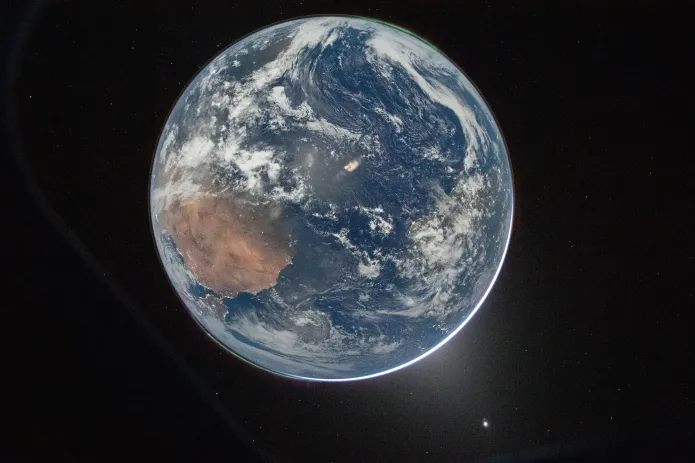

Last time I posted a photo of our planet was when Bill Anders passed. It was a retweet. Sixty years have passed between the two shots. Each one makes me pause and appreciate how tiny we are.
A wind that blows past and does not return.
That’s simply what we are,
however angry and noisy some might be, at the end of the day, they’ll get
old, blow past and not return.
Man has dominated man to his harm.
Man has the capacity to invent the
extraordinary. Like the machinery to go to space, to take in picture this blue
marble we call home. In his gasping haughtiness though, he erects imaginary borders,
pretends he has rights over neighboors or previous earth citizens. He establishes
booklets he’s called passports that suppose some would have an easier life than
others.
Watching the misery of the world’s affairs might depress many. Marveling at such beauty captured on this photograph reminds me of the beauty of life. I’m convinced that Man has no capacity to fix what troubles us. I’m however neither nihilist nor hopeless. To the contrary, I rejoice at the inner peace that resides deep within me. For a good part, because I believe that I’ll get to experience that blue marble for ever.
Note: the developer in me wonders at seeing one webpage weighing
16.7MB. On the other hand,
it’s cool to see that NASA provides an image resizer endpoint, I fetched the
image used here with
https://www.nasa.gov/wp-content/uploads/2026/04/art002e000192.jpg?w=695. You
can give any value to the w parameter to get the image version you want.
Style it, ship it
As getting the data from Strava and transforming it is now solved, what’s left is styling the spakline and making it part of an automated publishing process.
By using sal and jq as explained in the last 2 articles, I get a list of
points. I can simply visualize the those points, as a sparkline, like so:
<svg>
   <polyline transform="translate(0,30), scale(1, -1)"
      points="0,5 3,8 6,6 9,6 12,7 15,5 18,3 21,11 24,2 27,11 30,8 33,11 36,12 39,13 42,7 45,15 48,5 51,14 54,16 57,21 60,13 63,21 66,21 69,24 72,11 75,6 78,8 81,8 84,5 87,15 90,5 93,4 96,3 99,4 102,2 105,3 108,3 111,4 114,2 117,2 120,4 123,4 126,3 129,3 132,6 135,4 138,8 141,6 144,8 147,7 150,6 153,6"
      fill="transparent"
      stroke="#aaa">
   </polyline>
</svg>
I simplified a tiny bit but the important part is those points. These are
what the jq transformation outputs.
And this renders like this:
As cool as it is, there’s still some work!
CSS Layout and Styles
I wanted to have the sparkline in the footer of my running blog, taking more space than that, actually the full viewport’s width.
So I started to brainstorm on Codepen. I obviously took inspiration in what GitHub did on its repositories page. Making the sparkline itself bigger, with some text around is nothing difficult. I just had to find the colors and dimensions I wanted. For the colors, I ended up with something close to what Strava uses.
To make it span the entire width of the viewport, I then used
flex
ability to stretch an element. By duplicating the first and last points of the
sparkline and then put them in their own svg element, it’s been easy to
stretch those 2 points at the beginning and at the end of the sparkline to give
a sense of continuity.

Automate the whole process
runboyrun.ch used to run on an EC2 instance of Ghost. In the meantime, I slightly adapted the setup. I’m still using ghost but only locally to manage all my posts. By locally, I mean on my home network, it actually runs on a lightweight Lenovo laptop which runs as my cost friendly homelab.
The version publicly available is hosted on AWS S3 with Cloudfront as CDN. Again, more cost friendly, but makes more sense overall too.
That being said, I have my custom machinery to push new versions of that blog to S3. Nothing fancy, a bash script that’s polling the latest version of the blog from the local ghost instance and using the AWS cli to interact with S3 and Cloudfront to publish the new content and invalidate the CDN caches. Now on top of that, I integrated all the elements I just explained.
Every morning, a cron job executes that script which uses sal to fetch the
latest Strava activities. On my homelab server, sal uses a valid state.json
file to make the execution non interactive. Check out the previous
article if needed, I described how this file is used and where
it’s stored.
Then jq to transform the Strava activities into a series of points that are
then added to the blog content via a m4
include macro.
I quite like this solution and honestly I love checking out runboyrun.ch the next day of a run. That’s just one more thing that keeps me motivated to keep that line moving and that yearly distance above 1000 kilometers.
It’s been a fun side project.
From my Strava activites into one sparkline
With sal it’s now possible to fetch on demand all my personal Strava
activities from the past year. The next step is to transform this raw dataset into
a sparkline. But before diving into this, let’s see concretly how to install
and start using sal.
Setup walkthrough
sal’s README explains it all, let’s go
through this step by step.
-
On Strava, create an API Application.
-
Fetch
salfrom the GitHub repository’s release section or build it on your machine. -
Launch
sal. You’ll need a browser to complete the first launch as it has to fetch an authentication token and ask for your approval in doing so.You’ll need the
client_idand theclient_secretthat got generated on step 1 as well. They are available anytime on the settings page of your Strava profile.SAL_CLIENT_ID=<your_client_id> SAL_CLIENT_SECRET_ID=<your_client_secret_id> sal -
Under the default root directory for user-specific configuration, you’ll find the authentication details that
salwill use on further launches. Those are stored undersal/state.json. That will come handy later.
If everything is alright, that should be it, the past year of Strava activities are dumped in your terminal!
Raw data into a sparkline
That dataset is an array of activities. To transform that into a sparkline, that needs to go through a few steps of transformations.
The idea is to get the total distance per week and then to plot those 52 points on a line. Besides that, one or two other stats are computed so that we can generate the accompanying text.
The whole pipeline uses jq and m4. The bulk of the process is the following:
|
|
A whole bunch of things are taking place 🤠:
mapandselectfilters the dataset to retain only running and trailrunning activities- another
maptransforms each entries to pick only the distance and the date of the activity; the%g%Vdate format creates a key we’ll use to group activities of the same week. For example for today2608is%g%V group_byprepares the dataset so that we can make a total per week, it produces an array of activites per week, or more precisely per%g%V- the next
mapsums all the activites of each week - to ensure there’s no hole in the series, another array is created. It contains the 52 past weeks and an initial distance to zero
- next, it groups the 2 arrays in one, with the week as key
- for each week, it sums the
.distancekey, from each array; if I don’t run on a given week, this would ensure that I still have a datapoint for that week. At that stage, the dataset is made up of week keys and _distance values, as in[{"2607": 42}, ...]. - lines 10-11 normalize the
.distancevalues - lines 13-14 are the final touches to generate the 52 datapoints that we are
going to draw with svg. The
. * 3is for the width of a given week. So the whole sparkline would be approximately 160px wide. There was definitely a bit of playing around before I’d end up with a pleasing rendering activities.jsoncontains the output ofsal, the past 52 weeks of Strava activities
So SL_DATAPOINTS contains the datapoints, something like 0,6 3,3 6,5...,
and are included in a m4 template that I prepared.
More on this next step, in yet another upcoming and final post about this fun little side project.
Visualizing my year of running with one sparkline
Around 2010, I started running. Regularly. I was going through a very tough time – betrayal, abuse and loss of trust. That was my darkest period. It took me years to recover some self-esteem and my usual cheerfulness. Although I’ve never lost hope, I often felt powerless and stuck.
Running became an outlet that helped me greatly rebuild myself, to this day it helps me to balance my emotions, to process my life and expand my gratitude.
Thanks to running, I know that I may show a good dose of grit. I know that I can be disciplined enough to follow a training program to be fit to run a marathon at a given pace.
Thanks to running I’ve had unforgettable experiences. I’ve seen places, I’ve strengthened friendships. I’ve marveled at what our body is capable of achieving.
I’ll always be thankful that running is there.
Early came technology to the mix, I’ve used initially Runkeeper as a platform to track my runs. I think I purchased my first training programs there too. It started with half-marathon goals. Later came Strava, that’s where I post my runs until this date.
I used to have a subscription on Strava and that meant having access to a whole bunch of different tracking data. I would from time to time check my yearly progress in elevation, distance, etc.
But I dropped that subscription a couple of years ago as my running volume decreased drastically. New (happy) life priorities.
With no subscription comes less statistics, that’s part of the deal. But Strava provides an API you can use to fetch all your personal activities.
I’m using this API to generate a sparkline on my running blog. That one gives me the one statistic that I still like to look at: yearly distance.

To generate and publish it automatically I’m using sal a command-line tool I’ve created to first fetch the data needed.
I chose Go to build sal because I’ve been reading a couple of Go codebases over the past 2 years1, found nice what I read and thought this command line utility would be a perfect side project to get some practice. I liked especially how easy it’s been to generate cross-platform binaries. Knowing that I’m developing on a MacBook and that my goal was to run this little thing on my tiny home server running a Linux distro, that cross-compiling feature has been a decisive factor!
Every day, sal downloads all my Strava activities from the past year, 52 weeks and stores them in a JSON file. I get all the details I need in there, specifically distance, the type of the activity and its datetime.
That’s the foundation.
Then how do you transform this raw dataset into a sparkline? I’ll describe that second part in another post.
I migrated all my tweets, here's how
On how I reclaimed my tweets and imported them into my personal website
About a year ago, I closed my twitter account. Before pulling the trigger though, I’ve exported my personal content as I knew that I did not want to loose all that history of my online presence.
Funnily, that export feature still matches the Twitter branding, the guys from X did not bother taking care of that.

I got in my mailbox a fully functioning static website. Where I could browse my own feed as if Twitter still existed. You can search, filter and sort the feed as you please, all locally. The web as I like it.
I did not know what I would do with that archive a year ago. I just wanted to close my account without loosing my content. As I decided to resume my personal website, I knew that my tweets would get a new home in there.
Here’s how I migrated that content.
When you browse the archive you quickly find where to go. And as it’s a static website anyway, you can figure out how the whole thing works by looking to the sources.
twitter-archive> tree -P '*.html' -L2
.
├── assets
│   ├── fonts
│   ├── images
│   └── js
├── data
│   ├── community_tweet_media
│   ├── deleted_tweets_media
│   ├── direct_messages_group_media
│   ├── direct_messages_media
│   ├── moments_media
│   ├── moments_tweets_media
│   ├── profile_media
│   ├── tweets_media
│   └── tweets.js
└── Your archive.html
The entire collection of tweets is in app/tweets.js. From there to my own
website, it’s a matter of using a few tools to filter and re-shape that array
of microblog entries.
First, I simply kept the json compatible part of app/tweets.js, i.e. I
dropped the javascript variable declaration. I saved that into preprocess1.json.
Second, I decided to filter out any replies as I just wanted to keep my own posts. That would be too much of work to bring replies into their context, not even sure that it would be feasible at all.
jq '[.[] | .tweet.id as $id
  | ( .tweet.entities.media | length > 0 ) as $hasMedia
  | select(IN(paths; ["tweet", "in_reply_to_user_id"])==false)
  | del(
    .tweet.extended_entities,
    .tweet.favorite_count,
    .tweet.id_str,
    .tweet.truncated,
    .tweet.retweet_count,
    .tweet.id,
    .tweet.possibly_sensitive,
    .tweet.favorited,
    .tweet.entities.user_mentions,
    .tweet.entities.symbols,
    .tweet.entities.hashtags,
    .tweet.retweeted,
    .tweet.edit_info,
    .tweet.source,
    .tweet.display_text_range)
   | .tweet.entities.media
   |= if $hasMedia then $id end]' preprocess.1.json > preprocess.2.json
That filtered out about a third of my tweets.
Then I re-shaped the tweets. For example, the json payload gives the expanded URLs of any shortened link present in a tweet:
{
    "tweet" : {
      "entities" : {
        "urls" : [
          {
            "url" : "https://t.co/FhmBWq39rL",
            "expanded_url" : "https://activitypub.rocks/",
            "indices" : [
              "178",
              "201"
            ]
          }
        ]
      },
      "created_at" : "Fri Nov 01 11:54:07 +0000 2024",
      "full_text" : "\"Don't you miss the days when the web really was the world's greatest  decentralized network?  Before everything got locked down into a handful  of walled gardens?  So do we.\" – https://t.co/FhmBWq39rL",
      "lang" : "en"
    }
  },
I definitely don’t want to use the twitter URL shortener anymore. Thanks to that thorough payload, it was easy for me to translate them.
A multipass of the following jq script would convert all the shortened URLs into their expanded version.
cat preprocess.2.json | jq '[.[]
  | .tweet.entities.urls[0]?.url as $url
  | .tweet.entities.urls[0]?.expanded_url as $expanded_url
  | (if $url then .tweet.full_text
  | sub($url; "<a href=" + $expanded_url + ">" + $expanded_url + "</a>")
    else .tweet.full_text end) as $text
  | { tweet: {
      full_text: $text,
      lang: .tweet.lang,
      created_at: .tweet.created_at,
      entities: {
        urls: .tweet.entities.urls[1:],
        media: .tweet.entities.media
      }
    }}]' > preprocess.3.json
Once the content reshaped, I created one file per tweet under the notes section of my hugo website. I’ve used a bash script for that:
#!/usr/bin/env sh

file='preprocess.5.json'
length=$(cat "$file" | jq '. | length')
i_tweet=1

for (( i=0; i<length; i++ ))
do
    created_at=$( jq -r ".[$i] | .date | todate" "$file")
    output_folder="output/tweets/$(( i_tweet++ ))"
    out="$output_folder/index.md"
    hasMedia=$( jq ".[$i] | if .tweet.media then true else false end" "$file" )
    lang=$( jq -r ".[$i] | .tweet.lang" "$file")
    content=$( jq -r ".[$i] | .tweet.full_text" "$file")
    template='tweet.pre'

    if $hasMedia = "true" ; then
            template='tweet-with-media.pre'
            filename=$( jq -r ".[$i] | .tweet.media" $file)
            media=$(basename $(ls tweets_media/"$filename"*))
            if [[ "$media" == *.mp4 ]]; then
     	       mediaHtml="<video autoplay loop src='/notes/$media' class='u-video'></video>"
            else
     	       mediaHtml="<img src='/notes/$media' class='u-photo' />"
            fi
    fi
    data=$( m4 -D__CREATED_AT__="${created_at}" \
            -D__LANG__="$lang" \
            -D__CONTENT__="$content" \
            -D__MEDIA__="$mediaHtml" \
            $template)
    mkdir -p "$output_folder"
    echo "$data" > $out
done
That uses m4 too, simply to keep the templating outside, just a bit easier to
manage.
Here’s for example how I prepared tweet.pre. The bash script would either use
this one or tweet-with-media.pre depending on the presence or not of a media
in the tweet.
changequote(<!, !>)
---
date: __CREATED_AT__
lang: __LANG__
params:
  kind: tweet
---
<p>__CONTENT__</p>
<p class="meta original-link">
First published on <a href="https://twitter.com">twitter</a>
(<a href="/articles/1/">?</a>)
</p>
That’s it! 3143 tweets kept intact, now persisted on my own website.
I migrated all my instagram photos, here's how
On how I reclaimed my instagram posts and imported them to my personal website
Instagram provides an export feature, not easy to find but the help section provided me with the right sequence of clicks. I did that in September this year. You can choose between json and html exports, I chose json and received shortly after a zip file in my mailbox. Once deflated that amounts to 85 megabytes.
➜  instagram-jacqueminv-2025-09-04-83XcnSA4-json tree -d -L2
.
├── ads_information
├── apps_and_websites_off_of_instagram
├── connections
├── media
│   └── posts
├── personal_information
├── preferences
├── security_and_login_information
└── your_instagram_activity
    └── media
./media/posts and ./your_instagram_activity/media.There was no description of the archive’s content so I browse and quickly found that all my posts were under your_instagram_activity/media/posts_1.json. I decided to ignore everything else. That means my stories, comments or likes are not migrated. What I want is all the photos and their metadata so that I can keep them on my website.
That json file contains a list of entries and each has one to many media linked to it. It’s straightforward to find the link to the media file, each one is referenced via a uri property. That’s the link to the file within the very same archive, under /media/posts.
Having sorted out the structure and what I wanted, I could start playing around on the command line. For that kind of task, jq is a good candidate.
Here’s how I proceeded to only keep the attributes I needed and prepare the payload for the next step:
jq -c '[ .[] | {title: .media[0].title, date: first(.media[].creation_timestamp), pictures: .media | del(.[].creation_timestamp, .[].title, .[].media_metadata, .[].cross_post_source), location: first(.media[].media_metadata?.photo_metadata?.exif_data[0]?)} ]' posts_1.json > preprocess.json
One unpleasant surprise was that special characters were badly encoded. As I sometimes wrote my descriptions in french, that ended in the json like “matinée” for “matinée”. I did not see customization options on the export page so what I did was going through all my entries and fix them manually. Annoying. But my export is made of less than 400 entries and not that many in french so in the end, not a huge deal either. Still surprising for a service coming from a mammoth like Meta! I did that on that preprocess.json as I had not noticed that at first.
Equipped now with that filtered json I simply needed to generate the html hugo files for each entry. To achieve that part I’ve used a bash script and m4 .
#!/usr/bin/env sh

file='preprocess.json'
length=$(cat "$file" | jq '. | length')
i_insta=1

for (( i=0; i<length; i++ ))
do
	created_at=$( jq -r ".[$i] | .date | todate" "$file")
	output_folder="output/photos/$(( i_insta++ ))"
	out="$output_folder/index.md"
	content=$( jq -r ".[$i] | .title | sub(\"\n\"; \"<br/>\")" "$file" )
	latitude=$( jq -r ".[$i] | .location?.latitude" "$file" )
	longitude=$( jq -r ".[$i] | .location?.longitude" "$file" )
	location=""
	if [ "$latitude" != "null" -a "$longitude" != "null" ]; then
		location="<p class='h-geo meta'><a href='https://www.openstreetmap.org/#map=15/$latitude/$longitude'>"
		location+="<data class='p-longitude' value='$longitude'>$longitude</data>, "
		location+="<data class='p-latitude' value='$latitude'>$latitude</data></a></p>"
	fi

	mediaHtml='<ul>'
	lengthMedia=$( jq -r ".[$i] | .pictures | length" "$file")
	for (( m=0; m<lengthMedia; m++ ))
	do
		media=$(jq -r ".[$i].pictures[$m].uri" "$file")
		mediaHtml+="<li><figure><a href='/photos/$media'>"
		if [[ "$media" == *.mp4 ]]; then
			mediaHtml+="<video autoplay loop src='/photos/$media' class='u-video'></video>"
		else
			mediaHtml+="<img src='/photos/$media' class='u-photo' />"
		fi
		mediaHtml+="</a></figure></li>"

	done
	mediaHtml+='</ul>'
	data=$( m4 -D__CREATED_AT__="${created_at}" \
		-D__CONTENT__="$content" \
		-D__MEDIA__="$mediaHtml" \
		-D__LOCATION__="$location" \
		insta.pre)

	mkdir -p "$output_folder"
	echo "$data" > $out
done
With the accompanying insta.pre given to m4:
---
date: __CREATED_AT__
params:
  kind: insta
---
__MEDIA__
<p>__CONTENT__</p>
__LOCATION__
<p class="meta original-link">First published on <a href="https://www.instagram.com/jacqueminv/">instagram</a> (<a href="/articles/1/">?</a>)</p>
After execution, my 359 insta posts found a new home. I just had to copy the posts folder that actually contains the photos and one video.
Hiatus terminus
On why I stopped updating my personal website and social media took over. Interested to know how to reclaim your own twitter and instagram content? That’s for a future article.
I closed my twitter account about a year ago. We have to agree that social media in general got ever more toxic over the years. The promises of connection failed short. Instead, that’s a feeling of exhaustion and sadness that predominate if I spend time there.
I was using twitter mainly to stay up to date around information technology at large. I started to use twitter in October 2007. I’m not and I’ve never been an hardcore user, that was a tool to an end. Still, over the years I amassed some content that I was for some reasons attached to. Same for instagram, I posted quite a few photos there but using the platform today, with its mix of ads and unsolicited content? Not for me.
The closure of my twitter account acted as a trigger.
I used to have my own website back then but over time, when my personal life took tough turns, I took a bit of distance from all this. Actually, I lost the motivation to stay connected, to code, to write (online), to explore programming languages, technologies. Instead I did more and more running, spent time with other (new) friends and kept up with other healthy routines. Programming has been purely to get a paycheck, which is sort of sad considering how I did enjoy it before. Moving on takes time and for me it meant putting programming as a hobby on the side.
Fast-forward to years later, I moved to another place, continued to “rebuild” myself. The pinacle of that phase is when we decided to envision a life together, my now wife and I. Around that time I was even more disconnected, I was off, in heaven. That kept rebuilding me, for good and I could see that slowly my willingness to grow again in my programming, in setting a plan to give an answer to my thirst of knowledge made sense again. I started to regularly set time for my learning journey, not a huge amount as I have dear responsibilities I always strive to keep my best attention to. But learning was again in my routine, especially early mornings.
That led me to dig deeper into different areas over last years: kubernetes, css (boy how that part evolved), SRE topics, Terraform, and on and on. Learning, spending time to grow is again appealing and satisfying.
Writing always got its spot in my life. I’m excited to reclaim my own online space to keep track of my learnings and other wanderings. Social media may be tiring that’s a lesson. Producing my own content though is loaded with benefits: I know I can experiment if I have my own website, I know I can focus more on my own journey rather than looking what’s going on elsewhere passively. I mean that as a balance, staying up to date is still a goal and social media might be one way to do that. Reducing my time in staying connected to get more into producing, tracking my learnings is one clear goal of putting an end to my hiatus.
I’ll report about those learnings and lessons reaped along my way.
To start, I had in mind to reclaim my own content. Mainly the one spread on twitter and instagram. At least to start with. It’s now in good shape, there’s still a few fixes to apply but it got good enough for me to hit publish. All my tweets are in the notes section and all my insta snaps are in the photos section. The migration itself has been rewarding in terms of learnings, I’ll share about that next.
To me, I wish Happy Learning, Happy Hacking and long live to my own digital space.